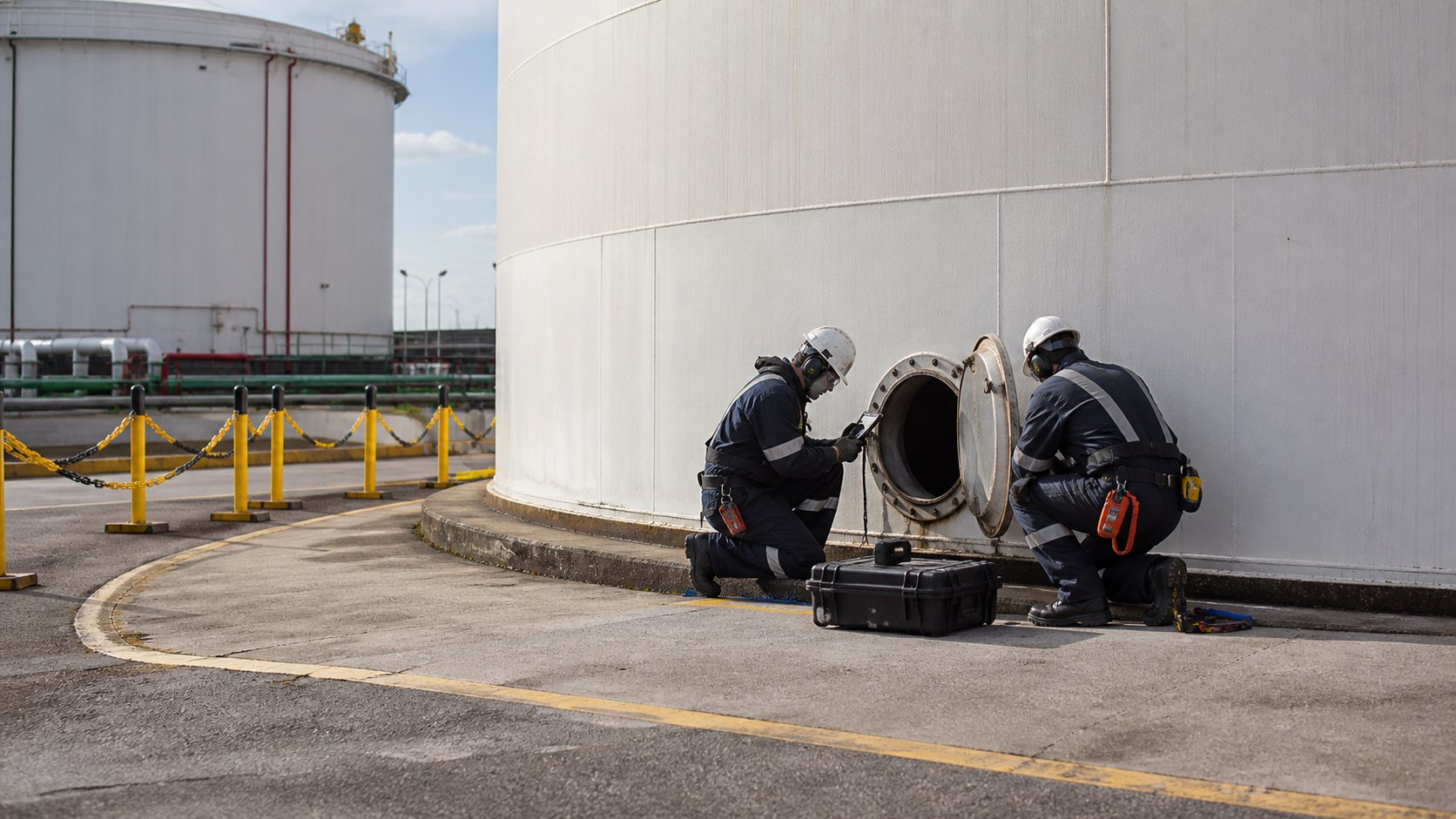
Large petroleum storage tanks are designed for long service lives, but long service does not mean unattended service.
A tank operates through repeated cycles of filling, holding and emptying while its shell, floor, roof, seals, nozzles and associated equipment remain exposed to operating and environmental conditions.
Maintaining that asset requires planning.
One of the most demanding periods is when a tank has to be removed from normal operation for inspection, repair or maintenance.
Removing a tank affects the wider terminal
Taking a tank out of service changes available storage capacity.
That can affect:
- customer inventory;
- product segregation;
- transfer planning;
- vessel schedules;
- pipeline movements;
- other tank allocations.
A turnaround therefore has both an engineering impact and an operational impact.
Planning needs to consider both.
The tank must first become a safe workplace
A storage tank containing petroleum cannot simply be emptied and opened.
Residual product, vapours, sludge and other hazards may remain.
Before personnel can enter, the tank must go through an appropriate process to isolate it from operating systems and establish conditions suitable for the planned work.
Depending on the asset and previous service, preparation can be a significant part of the turnaround.
This work should never be compressed simply to shorten the outage.
Inspection should answer a question
Inspection is most useful when the terminal understands what it is trying to learn.
The objective may include assessing:
- floor condition;
- shell integrity;
- corrosion;
- coatings;
- roof systems;
- seals;
- nozzles;
- structural components;
- associated piping.
Historical inspection records can help identify areas requiring particular attention.
The aim is not to generate the largest possible inspection report.
It is to understand whether the asset remains suitable for service and what work is required to maintain it responsibly.
Maintenance competes with time
Every additional day out of service can have a commercial impact.
But an incomplete repair can create a much greater future cost.
Terminal operators therefore have to manage the balance between:
- thorough work;
- safe execution;
- contractor coordination;
- inspection findings;
- material availability;
- operational demand.
Good turnaround planning reduces avoidable waiting without pressuring teams to bypass necessary work.
Returning to service is another controlled stage
Completion of physical repairs is not automatically the end of the turnaround.
The asset needs to be returned to operational status in a controlled manner.
That can involve inspections, reinstatement, equipment checks, documentation and confirmation that temporary isolations or work arrangements have been properly removed.
The objective is a tank that is not merely available again, but ready to perform its intended service.
Asset integrity is accumulated discipline
A major repair can attract attention because it is visible.
The long-term reliability of storage infrastructure is usually built much more quietly.
Routine inspection.
Corrosion monitoring.
Accurate records.
Maintenance of valves and seals.
Attention to small abnormalities before they become large ones.
Tank integrity is rarely the result of one maintenance event.
It is the accumulated result of decisions made throughout the asset's operating life.